
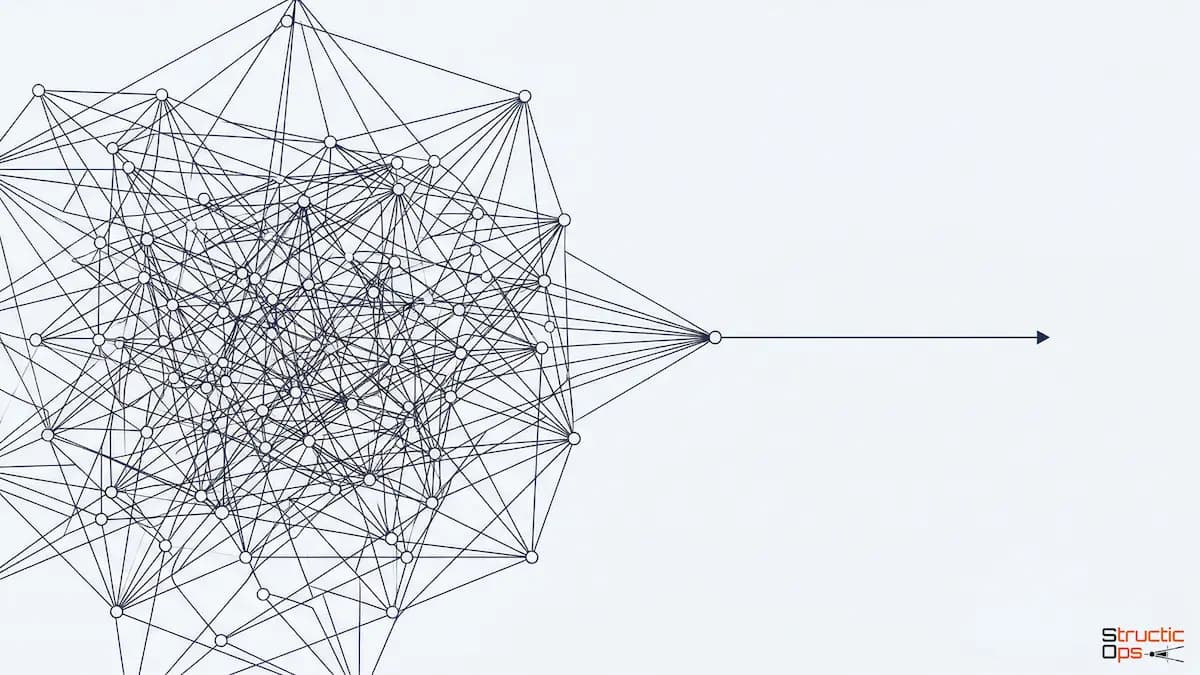
Hiring more people is the fastest way to kill a scaling company. Most leaders treat headcount as progress. In reality, it is a liability. Adding bodies to a broken process doesn’t accelerate delivery. It subsidizes dysfunction.
The Business Reality: Headcount vs. Throughput
This is the reality of Process Debt. It’s the manual workarounds that feel like “hustle” at 10 people, but become a paralysing tax at 100. Leaders who rely on individual excellence over architectural guardrails are building a fragile organization.
1. The Proximity Illusion
Relying on Slack DMs, tribal knowledge, and “proximity-based alignment” (endless sync meetings) to maintain productivity. This feels like agile “hustle” early on but becomes an unmanageable tax as the team expands.
2. The Scaling Gap
Hiring layers of middle management to supervise manual, unautomated, or implicit workflows instead of automating those workflows. The gap between what a hero engineer can deliver and what the organization can deliver becomes vast.
For Engineering Leaders: The Technical Delivery Breakdown
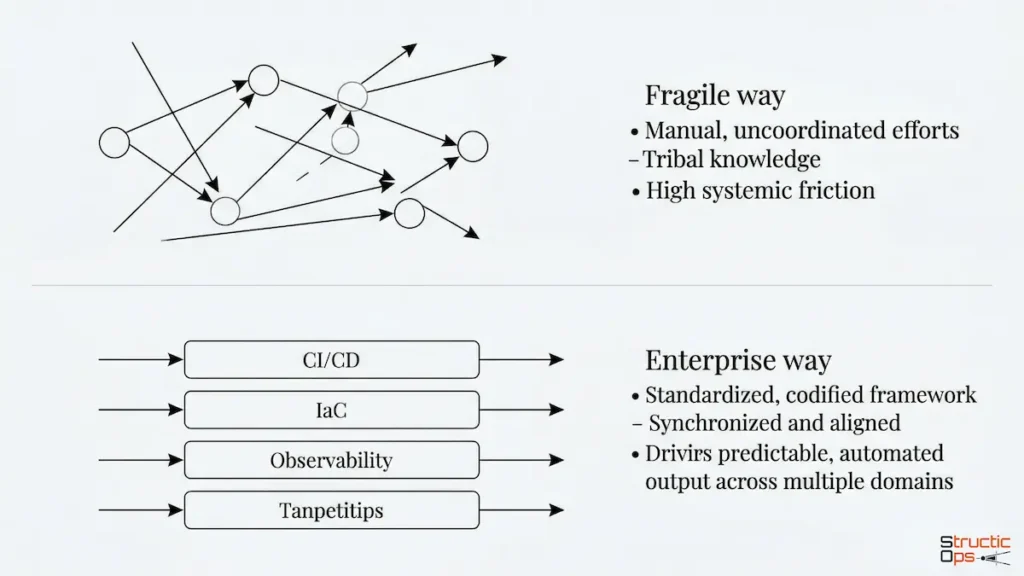
When systems lack structure, delivery relies entirely on the unsustainable cognitive load of individuals. The shift to maturity requires moving from proximity-based alignment to codified governance.
Anatomy of the Fragile Way
Technical Characteristics:
- Implicit Knowledge: Workflows exist in Slack DMs, internal Wikis, or the heads of “key” personnel.
- Manual Gates: Production deploys require specific human approval or complex checklists.
- Monolithic Thinking: Teams are divided by technology layer (e.g., Frontend vs. Backend) rather than business domain, forcing heavy cross-team synchronization.
- Tooling Heterogeneity: Zero standardized practices; every squad builds, tests, and deploys differently.
The Breaking Point:
Complexity rises exponentially ($N^2$ communication pathways). Eventually, your most expensive engineers spend 80% of their time on synchronization, conflict resolution, and manual testing rather than feature delivery. Velocity crashes, quality plummets, and burnout spikes.
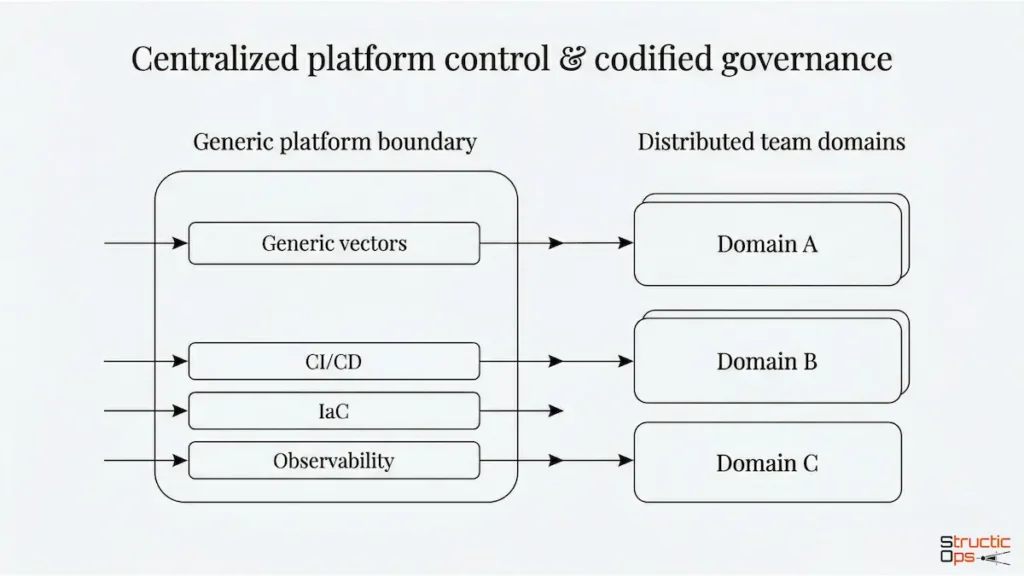
Anatomy of the Enterprise Way
Technical Characteristics:
- Explicit, Immutable Pipelines: The path to production is defined entirely as code.
- Automated Guardrails: Quality, security, and performance standards are enforced programmatically via static analysis and continuous integration.
- Domain-Driven Autonomy: Cross-functional teams own specific, bounded business domains end-to-end.
The Strategic Advantage:
Complexity is managed by the delivery operating system, not the humans. Output scales predictably because coordination is handled by APIs and platforms, rather than meetings and managers.
The Structic Ops Methodology: Governance as Code
True systems scaling requires encoding operational maturity directly into the architecture. We deploy these guardrails to stop the bleeding.
1. Codify Governance as Policy
Move beyond PDFs, Notion documents, and internal Wikis. Delivery rules—such as code coverage thresholds, dependency management, and security scanning—must be enforced as code in the CI/CD pipeline. If the policy is not automated, it does not exist.
2. Treat Platform as a Product
Abstract away infrastructural complexity. Create platform teams dedicated to building internal tools (IaC templates, deployment pipelines, observability stacks) that other product teams consume. Provide standardized, “paved roads” to production.
3. Shift-Left Operational Standards
Define production-readiness before a single line of code is written. Embed observability, scalability, and security requirements into the definition of done (DoD). Teams must build systems that are operatable at scale, not just functional in staging.
4. Align Architecture to Conway’s Law
Your organizational chart must reflect your ideal system architecture. Align teams around cohesive business domains, not functional technologies. This minimizes cross-team dependencies and facilitates autonomous flow.
The Final Metric: Systems-Driven ROI
Hiring to solve Process Debt is a fundamental capital allocation failure. Institutional strength is not measured by the size of your engineering organization; it is measured by the predictability, throughput, and resilience of your systems. Stop expanding the team to patch broken workflows and start automating the delivery lifecycle. Only systems-driven scale is sustainable, profitable, and defensible.
#OrganizationalDesign #ScalingSystems #EnterpriseArchitecture #CTO