

The Capital Allocation Paradox: Why Engineering Choices Are Financial Liabilities
Choosing a technology stack is not an engineering debate.
It is a financial strategy.
When you write code or spin up a service, you are not just solving a technical problem.
You are locking in the company’s capital for the next 36 months.
The Builder’s Illusion
- Focuses purely on technical elegance, bleeding-edge frameworks, and immediate feature delivery.
- Views infrastructure choices as isolated engineering decisions decoupled from the balance sheet.
- Prioritises “custom-built” over “off-the-shelf” to maintain maximum control, ignoring the long-term cost of maintenance.
The Investor’s Reality
- Treats every architectural component as an appreciating or depreciating financial asset.
- Measures technical debt not as a backlog of bugs, but as a compounding interest rate that drains operational bandwidth.
- Understands that deploying a custom microservice today dictates future headcount, infrastructure costs, and delivery bottlenecks tomorrow.
The trap most scaling companies fall into is localised optimisation. Engineering teams are incentivised to build bespoke systems to solve today’s localised problems without calculating the Total Cost of Ownership (TCO) at enterprise scale. Good architecture acts as an appreciating asset, enabling the business to pivot and scale efficiently. Instead, fragile architecture becomes a hidden liability. It burns cash through invisible maintenance overhead, artificially inflates the engineering headcount, and ultimately cripples time-to-market.

For Engineering Leaders: The Technical Delivery Breakdown
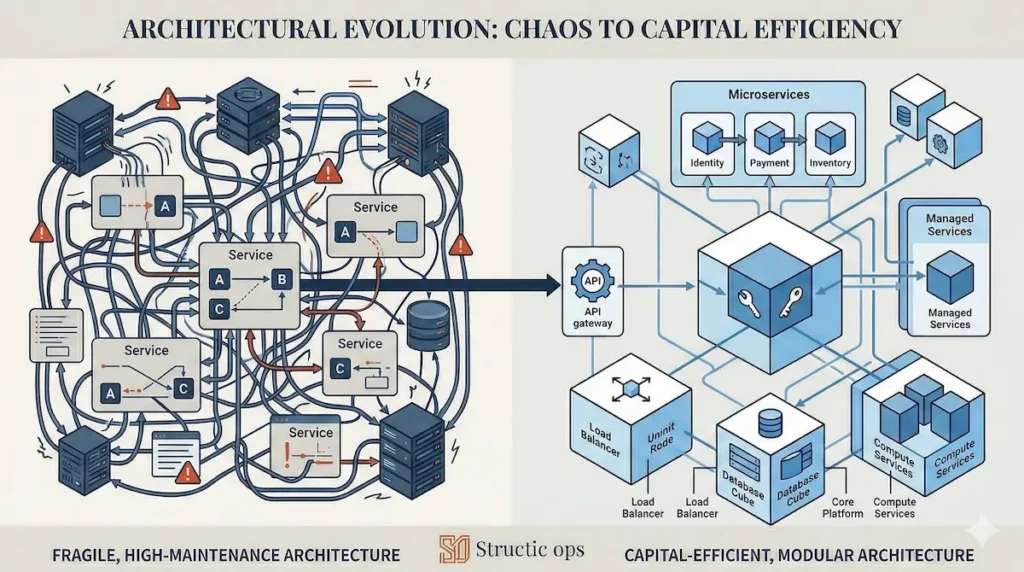
The Fragile Way (The Problem)
- Technical Characteristics:
- Defaulting to microservices for domains that lack strict bounded contexts.
- Building and maintaining custom internal tooling (auth, billing, logging) instead of leveraging managed SaaS.
- Unstandardized, snowflake deployment pipelines across different engineering squads.
- Over-engineering for hypothetical scale rather than current operational realities.
The Breaking Point: The system collapses under its own operational weight. The cost of maintaining the bespoke, fragmented infrastructure rapidly outpaces the value of the features it delivers. This leads to a bloated engineering organisation where 70% of capital and effort is spent merely “keeping the lights on,” paralysing the company’s ability to ship net-new value.
The Enterprise Way (The Solution)
- Technical Characteristics:
- Aggressive vendor leverage for all non-core capabilities, buying rather than building wherever possible.
- Deploying modular monoliths by default, extracting microservices strictly based on independent, data-backed scaling profiles.
- Treating platform engineering as an internal product with strict SLAs to standardise the developer experience.
- Implementing rigid “Governance as Code” to prevent architectural drift.
The Breaking Point (The Inflexion) The system scales linearly with revenue. Capital that was previously trapped in infrastructure maintenance and technical debt interest payments is suddenly liberated. This capital is reallocated to high-impact product development, dramatically lowering the cost per feature and accelerating market dominance.
The Structic Ops Methodology
1. The ‘Build vs. Buy’ Governance Matrix
Every architectural decision must pass through a strict capital filter. If a component does not directly generate competitive advantage or core IP, it must be outsourced to a managed service. Engineering cycles are reserved exclusively for revenue-generating logic.
2. Technical Debt Auditing
Technical debt is quantified not in story points, but in capital drain. We implement automated architectural guardrails that track the operational overhead of every service, ensuring technical debt is paid down before it compounds into an enterprise risk.
3. Standardised Capability Platforms
We eliminate rogue engineering by establishing a unified platform. By standardising CI/CD pipelines, observability, and infrastructure provisioning, we reduce onboarding time and ensure consistent capital efficiency across all engineering squads.
The Final Metric
At scale, the ultimate metric of engineering success is not deployment frequency, lines of code, or even system uptime—it is capital efficiency. When architecture is treated with the same rigour as capital allocation, technical leadership transforms from a traditional cost centre into a strategic, value-creating lever for the entire enterprise.
#EnterpriseArchitecture #CTO #ScalingSystems #StructicOps