
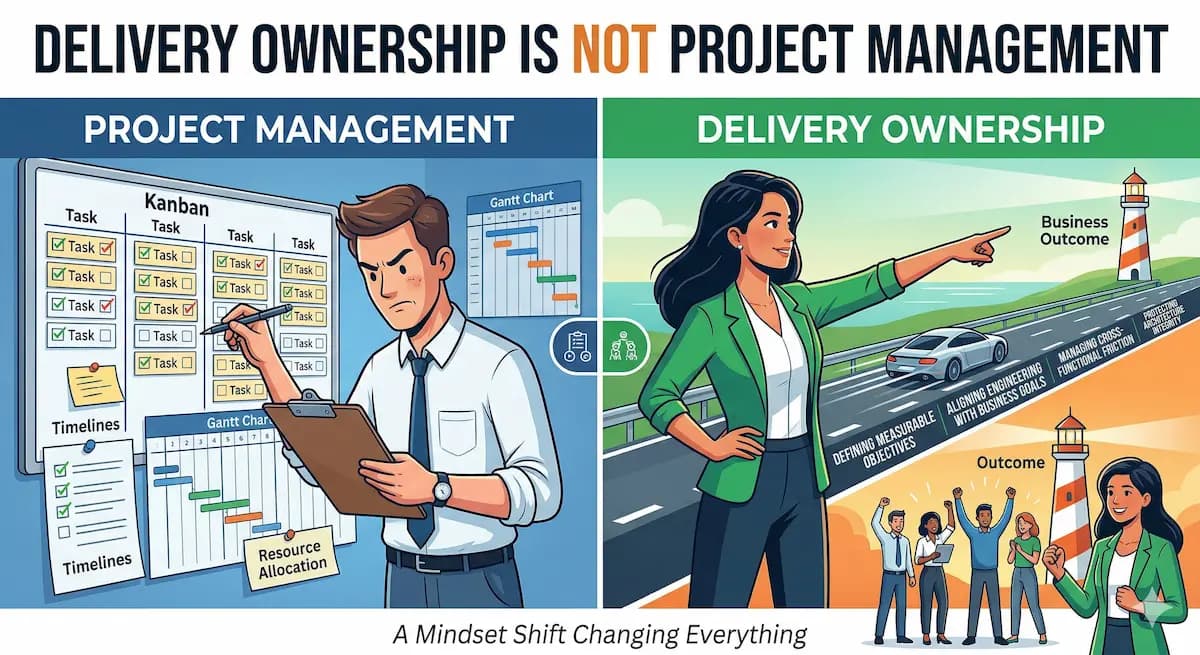
Project management is a clerical function. Delivery ownership is a strategic one. Most firms confuse the two until their roadmap collapses under its own weight. Activity is not progress.
The Project Management Reality
- Metric of Success: On-time ticket completion and “Green” Jira dashboards.
- Focus: Managing the schedule, documenting delays, and redistributing tasks.
- Risk Profile: Passive. Risks are logged in a spreadsheet and escalated upward.
- Communication: Status reports that provide data without context.
The Delivery Ownership Reality
- Metric of Success: Realised business value and architectural stability.
- Focus: Aligning engineering velocity with capital allocation and market windows.
- Risk Profile: Active. Bottlenecks are anticipated and dismantled before they impact the sprint.
- Communication: Radical transparency regarding trade-offs and technical debt.
The Scaling Gap: The “Task-Trap”
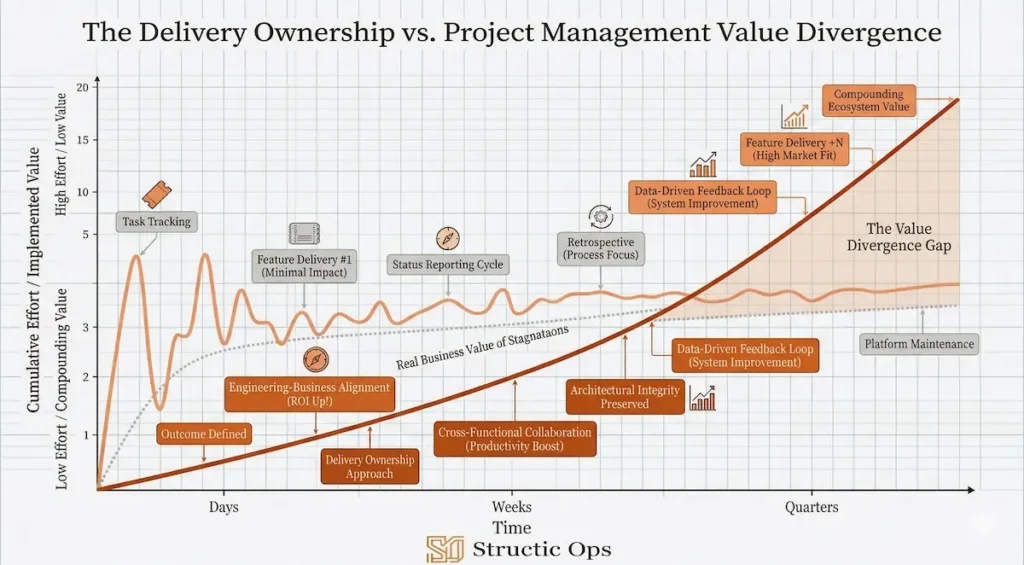
The trap most companies fall into is the belief that if every ticket is completed, the product will succeed. This leads to “feature factories” where engineering teams ship high volumes of code that provide zero marginal utility to the business. When you optimise for task completion rather than outcome ownership, you incentivise your best engineers to stop thinking strategically and start acting like assembly-line workers.
For Engineering Leaders: The Technical Delivery Breakdown
Anatomy of the Fragile Delivery Model
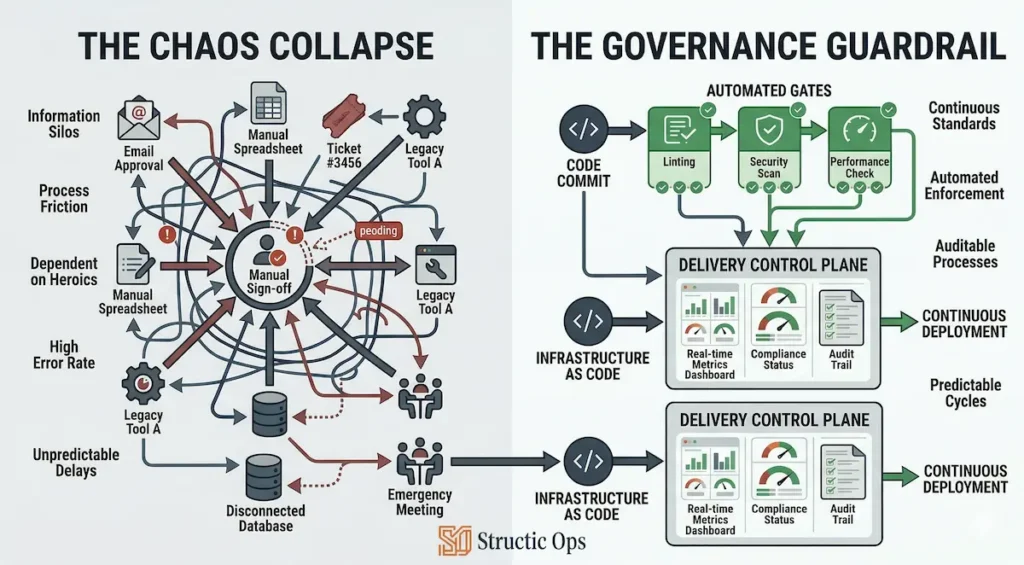
- Technical Characteristics: Manual hand-offs between Dev and Ops, an ambiguous Definition of Done (DoD), and local optimisations that ignore global system health.
- The Breaking Point: This model fails during the “last mile” of delivery. Integration hell, late-stage security caught-calls, and deployment friction turn a 2-week sprint into a 6-week ordeal.
Anatomy of the Enterprise Delivery Model
- Technical Characteristics: Automated CI/CD guardrails, “Shift-Left” security, contract-based testing, and observability-driven feedback loops.
- The Breaking Point: This model scales until organisational politics or “shadow IT” bypasses the established governance. It requires constant cultural reinforcement from the top.
The Structic Ops Methodology: Governance as Code
Ownership must be encoded into the system, not just the culture. We implement four specific architectural guardrails to ensure delivery is an outcome, not an accident.
1. Contract-First Development
Before a single line of implementation logic is written, service contracts must be defined and versioned. This decoupling allows frontend and backend teams to move in parallel without the “integration tax” at the end of the cycle.
2. Automated Quality Gates (The “No-Go” Protocol)
Ownership means saying no to subpar code. We implement hard-failure triggers for test coverage drops, security vulnerabilities (CVEs), and architectural violations. If the code breaks the system’s integrity, it cannot be merged—period.
3. SLO-Driven Prioritisation
Technical debt is managed by linking it to Service Level Objectives (SLOs). If a service falls below its reliability threshold, the delivery owner pivots the team’s entire capacity to remediation. This removes the “Product vs. Engineering” friction.
4. Post-Deployment Value Audits
Delivery does not end at git push. True ownership requires a 30-day lookback on every major feature to measure actual user adoption and system performance against the original business hypothesis.
The Final Metric: Capital Efficiency
At the executive level, delivery ownership is a tool for capital allocation. When you move from tracking tasks to owning outcomes, you reduce the “cost of delay” and increase your “return on engineering.” It transforms the engineering department from a cost centre into a predictable engine of institutional strength.
#TechnicalLeadership #OperationalExcellence #EnterpriseArchitecture #SystemsScaling