
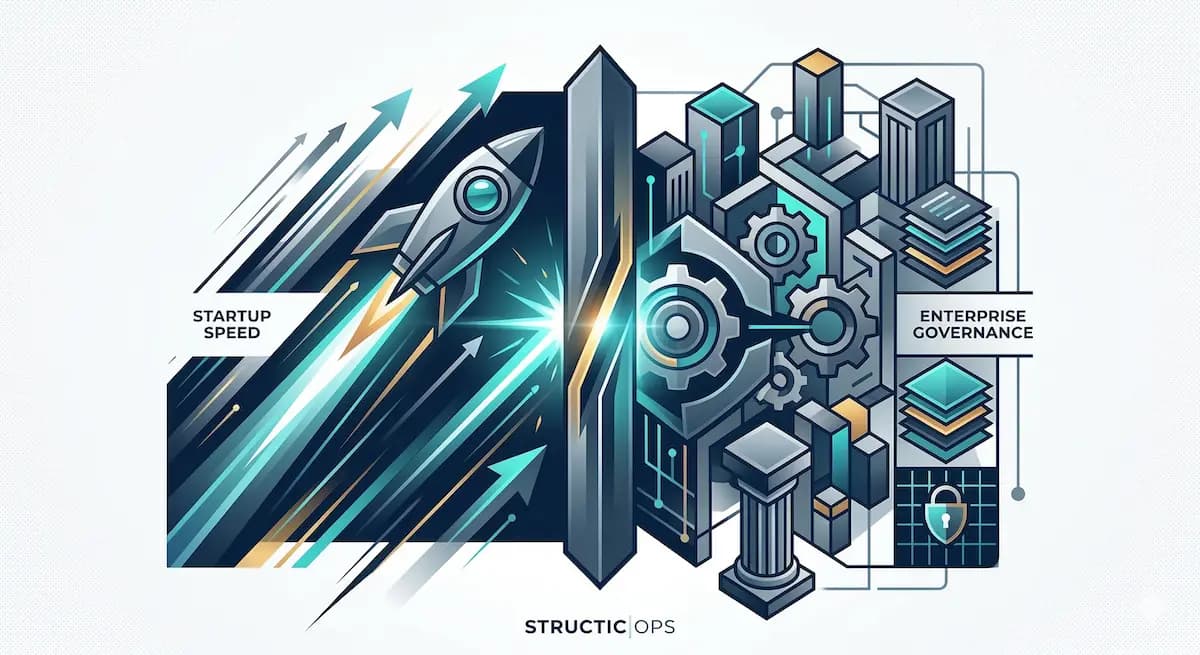
Moving fast is easy.
Knowing when to stop moving fast is where the real value is created.
In my career, I’ve operated at both ends of the spectrum: from the “move fast and break things” urgency of early-stage startups to the high-governance, high-compliance environments of global enterprises.
Most leaders pick a side. The best leaders learn to translate between them.
The Startup Reality: Speed as a Survival Tool
In a startup, Time-to-Market is the only metric that matters.
- Technical Debt is a strategic loan you take out to prove a concept.
- Processes are obstacles.
- Risk is embraced because the biggest risk is non-existence.
The Enterprise Reality: Risk as a Financial Liability
In an enterprise, Continuity is the metric that matters.
- Technical Debt is a high-interest liability on the balance sheet.
- Processes are the guardrails that prevent catastrophic failure.
- Risk is managed, mitigated, and insured.
The Scaling Gap
The “Scaling Failure” happens when a company grows its headcount but keeps its startup mindset. Or, conversely, when a startup adopts enterprise bureaucracy too early, it kills its innovation.
Strategic leadership isn’t about choosing one over the other.
It’s about Architecture and Governance. It’s knowing that you can afford a “dirty” hack on a frontend experimental feature, but you must have enterprise-grade governance on your core data layer.
The Governance Insight
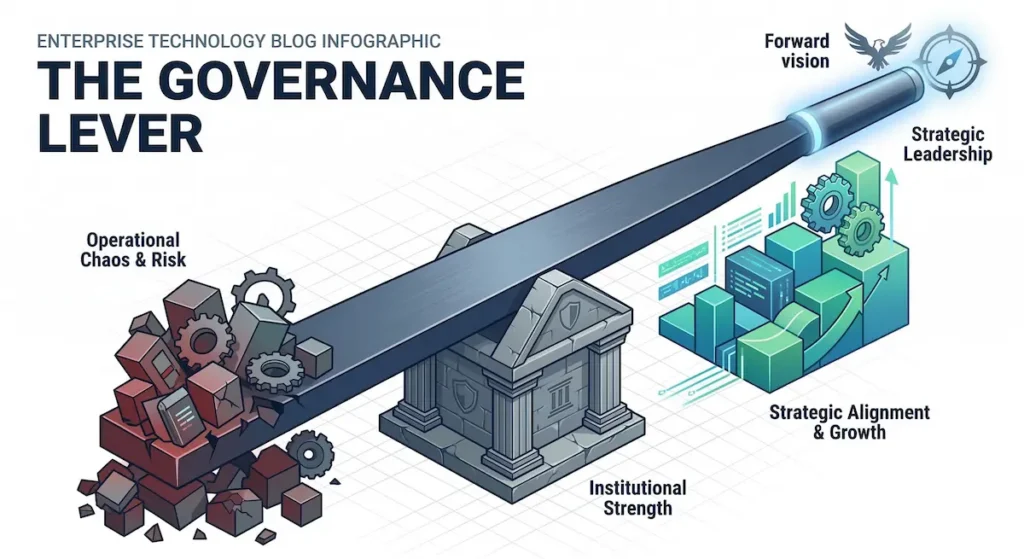
Governance is not a bottleneck. It is a growth lever. When you build the right systems, you don’t slow down. You create the stability required to move fast, at scale, without falling apart.
For Engineering Leaders: The Technical Delivery Breakdown
The transition from startup velocity to enterprise continuity is rarely a business failure; it is almost exclusively an architectural failure.
When a company scales headcount without scaling systems, the infrastructure buckles under the weight of its own operational debt. For Lead Architects and Engineering VPs evaluating our delivery models, this addendum breaks down the exact inflexion points where “startup architecture” becomes a liability, and how we engineer the bridge to enterprise-grade governance.
The Anatomy of Startup Architecture
In the zero-to-one phase, technical debt is a feature, not a bug. The architecture is designed to validate product-market fit with the least amount of capital expenditure.
Technical Characteristics:
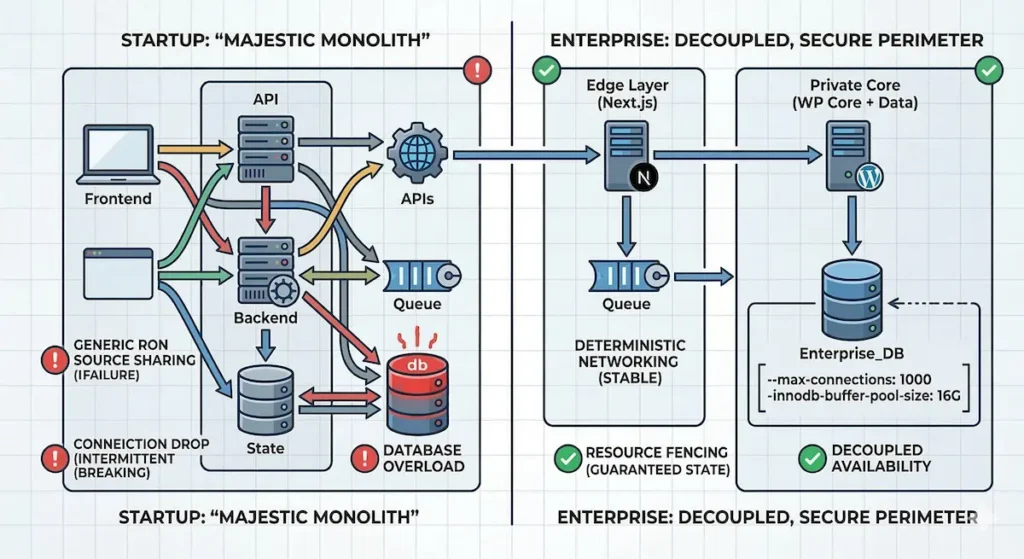
- The Majestic Monolith: Frontend, backend, and state are tightly coupled.
- Shared Infrastructure: Multiple services competing for the same resource pool (e.g., running web proxies and databases on the same unoptimized memory tier).
- Permissive Internal Routing: Generic service discovery where containers or microservices communicate via default network protocols without strict isolation.
- Manual Delivery: Deployments require human intervention, SSH access, and downtime windows.
The Breaking Point: This model fractures the moment traffic spikes or the engineering team grows beyond a single, tightly-knit unit. The symptoms are always the same: intermittent database connection errors, memory out-of-bounds (OOM) kills, and race conditions where services try to boot before their dependencies are ready. What was once “agile” becomes a fragile house of cards where a single malformed query or a generic internal DNS conflict brings down the entire application.
The Anatomy of Enterprise Architecture
Enterprise architecture does not simply mean “more servers.” It means introducing Delivery Governance at the foundational layer. The goal shifts from building features to guaranteeing the state.
Technical Characteristics:
- Decoupled State: Headless architectures where the presentation layer is physically and logically separated from the data layer and content management system.
- Resource Fencing: Strict memory allocation, buffer pool sizing, and connection limits applied at the container level. A spike in the proxy layer should never starve the database of RAM.
- Deterministic Networking: Unique, explicit service naming and isolated virtual networks to prevent cross-talk and ambiguity between microservices.
- Immutable Infrastructure: Infrastructure as Code (IaC) where servers are cattle, not pets.
The Cost of Premature Optimisation: Implementing this level of governance on Day 1 of a startup will kill the company through capital exhaustion. The art of the technology leader is knowing exactly when to introduce these enterprise constraints.
The Structic Ops Methodology: Governance as Code
We do not believe in rebuilding systems from scratch every time a company hits a scaling wall. Instead, we implement “Governance as Code”—a set of architectural guardrails that allow systems to scale seamlessly.
Here is how we execute the transition:
1. State Management and Connection Pooling
Startups fail when their databases are treated as infinite resources. As you scale, connection limits are hit rapidly, resulting in silent drops or intermittent site failures.
We implement strict container-level resource limits. By explicitly defining maximum connections and restricting buffer pool sizes relative to the host’s physical and virtual memory, we force the application to queue requests rather than crash the database. This turns a catastrophic failure into a manageable, temporary latency spike.
2. Network Isolation and Service Identity
In a growing multi-container environment, generic naming conventions lead to internal DNS conflicts and routing ambiguity.
Our standard delivery protocol requires namespace isolation. Every service receives a unique, project-specific identifier and operates on an explicitly declared external network. This eliminates cross-talk between isolated applications running on the same cluster, securing the internal perimeter.
3. Ephemeral Environments via Declarative Configurations
State desync between environments (Local, Staging, Production) is the leading cause of failed deployments. We eliminate this by enforcing strict declarative manifests where every environment variable, volume mount, and health-check dependency is codified. The environment must be reproducible in the same way, every single time, in under 60 seconds.
4. The Edge Delivery Layer
We push the compute burden as close to the user as possible. By coupling a hardened, private core engine with a globally distributed edge framework, we ensure that the backend is never exposed directly to public internet traffic. API routes act as the gatekeepers, handling transactional logic securely and asynchronously.
The Final Metric: Institutional Strength
Ultimately, architecture is about capital allocation. Every hour spent debugging an intermittent database connection is an hour stolen from product innovation.
By upgrading from Startup Thinking to Enterprise Delivery, you are not just writing better code. You are removing operational friction, securing your data layer, and building the institutional strength required to scale a global platform.
#TechnologyLeadership #EnterpriseArchitecture #ScalingSystems